A garage door is one of those everyday essentials most homeowners don’t think about—until something feels off. It’s the largest moving part of your home, opening and closing through a system of tension, weight, and timing. When everything is working in harmony, the door glides smoothly, quietly, and predictably. But when balance is lost, even slightly, the entire system can become unstable.
And an unstable garage door isn’t just annoying—it can be dangerous.
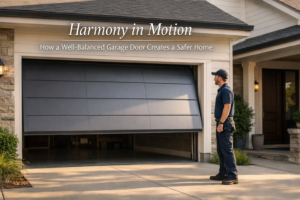
Garage door balance is what allows a heavy door to move as if it’s light. That “effortless” motion doesn’t happen because the door is easy to lift, but because the springs are doing the hard work behind the scenes. When springs are properly adjusted, they carry the weight of the door and keep it stable at every point in its movement. The opener simply guides it. When balance is off, the opener is forced to fight the door’s weight, and the system begins to wear down faster than it should.
That’s why balance matters. It keeps the garage door predictable, controlled, and safe.
When a garage door becomes unbalanced, it often shows up in small ways first. You may notice the door looks slightly uneven while moving. You may hear more noise than usual, or it may shake or hesitate as it opens. Some homeowners feel the difference when lifting the door manually, realizing it suddenly seems much heavier than it used to. These are early warnings, and they’re important because imbalance rarely stays “small.” It creates ongoing strain, and strain always leads somewhere—usually into a breakdown.
The biggest risk of imbalance is instability. A door that isn’t properly supported by its spring system can behave unpredictably. It may close too quickly, slam near the ground, or feel like it’s “dropping” rather than lowering smoothly. Even worse, the door may struggle to stay in position if it’s partially open. That can turn into a real safety concern in a busy household, especially when children, pets, or vehicles are nearby. A heavy door that loses control can cause injury or damage in seconds.
Another hidden danger is what imbalance does to the garage door opener. Most people think the opener is responsible for lifting the entire door, but in a healthy system, it isn’t. The springs are meant to handle the weight. When the door loses balance, the opener becomes overloaded and starts working harder than it was designed to. Over time, that extra stress can wear out internal gears, weaken performance, and reduce reliability. A struggling opener may also affect how the door responds during closing, and that matters because garage door safety systems depend on smooth, controlled movement to function correctly.
Balance also impacts the door’s alignment and how evenly it travels on the track. When tension isn’t evenly distributed, the door may pull slightly to one side. That might not look like a major issue at first, but it causes uneven wear on rollers, cables, and hardware. The movement becomes rougher, noisier, and less stable. And in some cases, imbalance can even contribute to track problems, where the door no longer glides cleanly in its path.
But beyond mechanical performance, there’s another reason balance matters: security. If a garage door is struggling to close evenly, it may not seal properly at the bottom. Small gaps can form, and the door might not sit flush. That can affect insulation, allow pests to enter, and weaken the overall security of your garage. Since many garages connect directly to the home, a garage door that doesn’t close correctly becomes more than a convenience problem—it becomes a vulnerability.
The good news is that balance problems are often detectable before they become serious. A garage door that operates smoothly should feel calm and steady. It shouldn’t jerk, shake, or slam. It should rise evenly and close in a controlled way. If something feels different, that’s your system communicating that something is shifting—springs may be wearing down, tension may be uneven, or hardware may need adjustment.
It’s also important to understand that garage door spring adjustment is not a DIY task. Springs store a significant amount of tension, and handling them without training can be dangerous. A professional inspection is the safest way to confirm whether your door is balanced and whether the system is operating within safe limits. A garage door repair Palm Desert technician can test the balance, measure the spring tension, check cable condition, and ensure the opener isn’t being forced to overcompensate.
When a garage door is properly balanced, the entire system lasts longer and works better. It feels smoother. It sounds quieter. It becomes more reliable. And most importantly, it creates a safer environment because the door behaves predictably every single time it moves. That stability is what protects your family, your vehicles, and your home.
In the end, harmony in motion is not just a poetic phrase—it’s a real mechanical reality. A balanced garage door is safer because it’s controlled. And control is what prevents accidents, unexpected failures, and expensive breakdowns.
If your garage door feels heavy, uneven, or louder than usual, it may be time for a professional tune-up. Because a safer home starts with something simple: a garage door that moves the way it should.